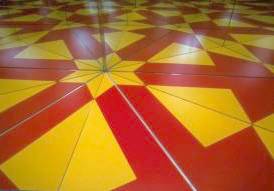
Each one of the
mirror boxes is provided with some tiles, which are the right ones in order to
see in the box a given picture (which will be a tessellation of the plane):
some of these pictures
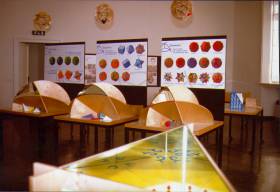

are shown on the walls of the box, so that the visitor
knows in advance in which one of the three boxes he will be able to build that
picture; other ones are shown mixed up in a poster, so that the visitor willing
to reconstruct that picture has first of all to decide in which one of the
three boxes this can be done. Mathematically, this is a first not trivial
problem: this decision corresponds in fact to detecting the symmetry group of
the given picture.
The 3-dimensional
caleidoscopes can be handled in an analogous way: some small pieces are
provided, which correspond to the fundamental domain[1]
for the action of the symmetry group on some polyhedra. By putting the piece in
the corresponding caleidoscope, the polyhedron is reconstructed.
Both in the
2-dimensional mirror boxes and in the 3-dimensional caleidoscopes the same
mathematical concept is underlined: the classification of something (a planar
picture in the first case, a solid object in the second one) with respect to
its symmetry group. So a “machine for building symmetry” builds up different
things, depending on what is put inside it, but all what is built with the same
machine has the same kind of symmetry; while different machines build up
different symmetries[2].
The
actual exhibition contains in fact other objects, which are all functional to
this main idea.
This
paper is organized as follows: section 2 is more technical and is directed to
the reader who likes to have a more detailed idea of the mathematical concepts
underlying the objects just described; section 3 contains a discussion about
different ways for using these “machines”, with different sorts of public.
Readers mainly interested to this discussion can skip directly to section 3.
2. The mathematics underlying
the machines for building symmetry.
2.1
Coxeter groups
Coxeter, in a series of papers around
1930, began to study those subgroups of the isometry group in Rn having the two properties
of being discrete and being generated by reflections in hyperplanes. These two
properties are exactly what is necessary in order to “see” the group in a
system of mirrors. In order to explain what we mean, we shall first illustrate
a couple of examples in the plane.

Let G be the group generated by the
reflections r and s in two lines r and s, making an angle
of p/4 in point O. G is a finite group, consisting of four rotations (with
center O and angles, respectively, p/2, p, 3p/2, 2p) and four reflections, with respect to the two lines r and s and other
two lines t and u (see figure 1); the set of these four lines is the complete set of hyperplanes related to
the group G (that is, the maximal set of hyperplanes such that the reflection
with respect to that hyperplane belongs to the group); the connected components
of the complement, in the plane, of these four lines are the chambers of the group G. All the
chambers are equivalent (in the sense that there exists an element of the group
sending one into the other), each one of them is an angle and the group is
generated by the reflections in the walls of any chamber. There is a bijection
between the whole set of the chambers and the elements of the group: fixing one
of the chambers R0, the bijection is obtained by sending any other
chamber R into the element g in G such that
g(R)= R0.
In order to consider another example,
let H be the group generated by the reflections a, b, c in the three sides of a right
isosceles triangle. H is an infinite group, and the complete set of hyperplanes
is sketched in figure 2:

It is an infinite grid, and the complement of this grid in the plane is
made up of an infinity of isometric triangles, which are the chambers of the
group.
It is worthwhile observing that, in both
cases, the complete set of hyperplanes (and, as a consequence, also the set of
the chambers) is just what we see if we start from a set of mirrors (two in the
first case, three in the second one) corresponding to the generators of the
group.
In fact, when we say that we are “seeing the group”, we are
not referring only to the fact that the chambers we see are in one-to-one
correspondence with the elements of the group, but, also, to the possibility of
reading out from what we see the presentation of the group with generators and
relations: in the case of figure 1, the group G is generated by r and s with relations r2
= s2 = (rs)4 = 1; in the case of
figure 2, H has three generators a,b,c
and relations a2 = b2 = c2 = (ab)2
= (bc)4 = (ac)4 = 1. In
the photo, we can see another example, corresponding to thegfroup with three
generators a, b, c and relations a2 = b2 = c2
= (ab)2 = (bc)3 = (ac)6 = 1.

This situation is quite general: any Coxeter group has a
presentation with k generators g1,…,gk and relations of
the kind (gigj)Nij=1; if i=j, Nii=1,
as each gi is the reflection in a hyperplane; if i¹j, p/Nij is the angle between the
two hyperplanes associated to the generators gi and gj.
From a geometric point of view, one can
prove that any (irreducible[3]) Coxeter group is generated by the
reflections on the walls of a chamber which can only be:
·
a simplex, if the group is infinite;
·
the cone on a simplex, if the group is
finite.
There are other limitations on the
shape of these chambers, which lead to the complete enumeration of Coxeter
groups in any dimension; this is reached through an analysis which is quite
lengthy in the general case, but, in low dimensions, is essentially a
consequence of the observation that, due to the discreteness of the group, the
dyhedral angles between the walls of the chamber must be of the form p/n, where n is any positive integral number (³2). This leaves very few possibilities, that is:
1. for finite groups in two dimensions: two mirrors making an angle of p/n (for any n in N); the
chamber is the cone on a 1-dimensional simplex;
2. for infinite groups in two dimensions: three mirrors forming a
triangle, with angles p/p, p/q, p/r. As 1/p + 1/q + 1/r = 1, the only
possibilities are:
·
p=q=r=3: equilateral triangle;
·
p=2, q=r=4: right isosceles triangle;
·
p=2, q=3, r=6: right triangle with angles
p/3 and p/6;[4]
3. for finite groups in three dimensions: three mirrors forming the cone
on a triangle. The angles between the mirrors must be of the form p/p, p/q, p/r; as these
are the angles of the corresponding spherical triangle, we get the inequality
1/p + 1/q + 1/r > 1, which leaves the only possibilities:
·
p=2, q=r=3: this corresponds to the
symmetry group of a tetrahedron;
·
p=2, q=3, r=4: this corresponds to the
symmetry group of a cube, or of a octahedron;
·
p=2, q=3, r=5: this corresponds to the
symmetry group of a dodecahedron, or of an icosahedron.

The six cases just obtained in 2. and
in 3. are exactly the six “machines for building symmetry” described in the
introduction.
In order to complete the list of
Coxeter groups acting in dimension less or equal to 3, we have to add also:
0. groups in one dimension: there is only one finite group, corresponding
to just one mirror; there is also only one infinite group, corresponding to two
parallel mirrors.
4. infinite groups in three dimensions: these are given by four mirrors
forming a tetrahedron with all dyhedral angles of the form p/n; there are three possibilities, whose corresponding chambers are all
shown in figure 3:
5.

·
the tetrahedron of vertices O,V,O’,V’,
which has two dyhedral angles equal to p/2 and four
equal to p/3;
·
the tetrahedron of vertices O,V,O’,M,
which has three dyhedral angles equal to p/2, two
equal to p/3 and one equal to p/4;
·
the tetrahedron of vertices O,V,H,M,
which has three dyhedral angles equal to p/2, one
equal to p/3 and two equal to p/4.
2.2
Two-dimensional machines and plane
cristallographic groups
In
the last subsection we found three irreducible cases among Coxeter infinite
two-dimensional groups (equilateral triangle, right isosceles triangle, right
triangle with angles p/3 and p/6) and
one reducible case (rectangle). The same four cases appear among
crystallographic groups, that is discrete groups of isometries in Rn, whose translation subgroup is generated by
n independent translations. For n=2, these are the 17 (up to affine conjugacy) wallpaper groups; among them, the ones
which are generated by reflections are Coxeter groups (reducible or
irreducible), and there are four of them:
·
p3m1
corresponding to the
mirror box with the shape of an equilateral triangle;

·
p4m
corresponding to the
mirror box with the shape of a right isosceles triangle;

·
p6m
corresponding to the
mirror box with the shape of a right triangle with angles p/3 and p/6;

·
pmm
corresponding to the
mirror box with the shape of a rectangle.

It is
also interesting to notice that these four groups are not the only ones – among wallpaper groups – which can be
seen in our “machines”: in fact, when we put something in a mirror box, the
planar picture we get has a symmetry group
which contains the group G
associated to the box (that is, the group generated by the reflections in the
walls of the box), but not necessarily coincides with it. If we put in the box
something which already has some symmetry, what we get is a group H which
properly contains G as a subgroup and we may also “read” the index of G in H[5].
So, if we want to make a list of which ones of the 17 wallpaper groups may be
seen in our machines, we have to add some cases, that is:
·
p6m
is not contained as
a proper subgroup in any of the other 16 groups; so in the mirror box with the
shape of a right triangle with angles p/3 and p/6 we
can only see something with symmetry group p6m[6];
·
the
same happens for the group p4m corresponding
to the mirror box with the shape of a right isosceles triangle[7];
·
p3m1
is contained as a
proper subgroup of (minimal) index 3 in the

crystallographic group p31m so, in the box with the shape of an
equilateral triangle we generally see something with symmetry group p3m1 (by putting in the box something with
no symmetry at all); but we can also see a planar picture with symmetry group p31m, by putting in the box something
with symmetry group C3, that is a center of rotation of order 3 in
the center of the mirror box. p3m1 is
also contained as a proper subgroup of (minimal) index 2 in the crystallographic
group p6m; this is for us less interesting, as
it does not give a “new” group to see; however, in order to see the group p6m in the equilateral mirror box it is enough
to put inside the box something with a bilateral symmetry.
· pmm is contained as a proper subgroup
· of (minimal) index 2 in the group cmm;
·
of
(minimal) index 4 in the group p4g.
Besides these two cases,
which add two new groups to the list of the ones we can see in mirror boxes,
there are other two possibilities, as pmm is also contained as a proper
subgroup
·
of
(minimal) index 2 in the group p4m;
·
of
(minimal) index 6 in the group p6m.
Thus in a rectangular
mirror box we generally see something with symmetry group pmm (that is, this
happens when we put inside the box something without any symmetry); we manage
to get a picture with symmetry
group cmm

when we put inside the box something with a
center of symmetry of order 2 in the center of the rectangle. In order to get a
picture with symmetry group p4g,we
cannot start from any rectangular mirror box, but we need a square one,

and we have to put in the
square box something with symmetry group C4, that is with a
rotational center of order 4 in the center of the square. If we put in the square box something whose symmetry group
is the dyhedral group D4 we get a picture with symmetry group p4m, but in fact we can get the same group
(as a subgroup of index 2 instead of 8, that is by putting inside the box a
picture with just a symmetry axis along the diagonal of the square. In order to
get a picture with symmetry group p6m, we cannot start from any
rectangular mirror box, but we need one such that the ratio between its sides
is square root of 3 so that it can be divided in six right triangles with
angles p/3 and p/6, each
one obtained from the adjacent one by reflection in the common side: see figure
4.

So,
the wallpaper groups which can be seen in a mirror box are seven, the four ones
which are generated by reflections, and other three, which contain a subgroup
generated by reflections.
2.3
Three-dimensional machines and polyhedra
And what
about three-dimensional symmetry machines? The ones we described in the
introduction realise the only possible irreducible finite
subgroups of Iso(R3) generated by reflections, which correspond to
the symmetry groups of the regular polyhedra. As in the two-dimensional case,
the significative mathematical result hidden in these machines is the fact that
they are not just an example, but they are in fact the only possible cases.
As
in the two-dimensional case, by putting something in the “machine”, what one
sees is the orbit F of that “something” with respect to the group associated to
the caleidoscope (that is, the group generated by the reflections in the walls
of the caleidoscope); the symmetry group of F contains the group of the
caleidoscope, but does not necessarily coincides with it. However, finite
groups of isometries in the space are very few, so that for two of the
caleidoscopes (the one associated to the symmetry group of the cube and the one
associated to the symmetry group of the dodecahedron) we may be sure that
anything we see inside will always have a symmetry group which coincides with
the group of the caleidoscope: the reason of this is simply the fact that there
does not exist any finite group of space isometries containing as a subgroup
either the symmetry group of the cube or the symmetry group of the
dodecahedron.
Instead,
in the caleidoscope associated to the symmetry group G of the tetrahedron we may see either objects having G as
symmetry group or objects having the same symmetry group H of a cube (as G is a
subgroup of index 2 in H).
Colouring
can be used (here as in the planar case) to underline this phenomenon. For
example, an octahedron can be reproduced in the caleidoscope of the cube, but
if we colour it with black and white faces (each black face touching only white
ones, and viceversa) and we do want to reproduce that colouring also, then we
need the caleidoscope of the tetrahedron[8].
Of
course, regular polyhedra are not the only objects one can observe in the
three-dimensional caleidoscopes. To give another example, we can consider the
orbit F of a single point x with respect to the group associated to one of the
three caleidoscopes, and the convex envelope of the points in F: in this way,
we naturally get a uniform polyhedron (that is, a polyhedron whose symmetry
group is transitive on the set of vertices). In particular, we get in this way
nearly all the 13 Archimedean polyhedra:
· in the caleidoscope of the
tetrahedron we get also the archimedean
polyhedron (3,6,6)[9];
· in the caleidoscope of the cube we
get the archimedean polyhedra (3,4,3,4), (4,6,6), (3,4,4,4), (3,8,8), (4,6,8);
· in the caleidoscope of the
dodecahedron we get the Archimedean polyhedra (3,5,3,5), (5,6,6), (3,4,5,4),
(3,10,10), (4,6,10).
The only two archimedean
polyhedra which can not be seen
in the caleidoscopes are (3,3,3,3,4) and (3,3,3,3,5), whose symmetry groups
contain only rotations.
The
same construction does not only yield the Archimedean polyhedra (which, besides
beeing uniform, have regular faces): in general, for any choice of x, we always
get a polyhedron whose faces are equiangular; for each one of the described
cases, there is just one position for the point x such that the faces of the
corresponding polyhedron are also equilateral.
2.4
Elliptic, euclidean (and hyperbolic) geometry
Up to
now we spoke about two-dimensional and three-dimensional machines for building
symmetry; but there is another way - probably more suitable[10]
- to look at this situation. It should be noticed in fact that the world of
polyhedra can be handled in (at least) two different ways: we can think to a
polyhedron as a solid object (homeomorphic to D3), the analogous in
the three-dimensional space of what is a polygon (homeomorphic to D2)
in the plane; alternatively, we can think to a polyhedron as a two-dimensional
object (homeomorphic to S2). From this point of view a polyedron is
not so much the analogous of a plane polygon, but rather the analogous of a
plane tessellation. With the first point of view one rather sees the symmetries
of the object as isometries in the space; with the second point of view, one
thinks more about isometries of the sphere.
This
second point of view is probably the best one to underline the similarity
between the different situations shown with our six “machines for building
symmetry”. In any case we handle surfaces, more precisely triangulated
surfaces; with the first three machines, the mirror boxes, we are in the world
of euclidean geometry, and the restriction on the number of possible machines
comes out essentially from the equality
1/p + 1/q +
1/r = 1,
implied by the fact that
the sum of the angles of a euclidean triangle is equal to p; with
the other three machines, the caleidoscopes, we are in the world of elliptic
geometry, and the restriction on the number of possible machines comes out
essentially from the inequality
1/p + 1/q +
1/r > 1,
implied by the fact that
the sum of the angles of a spherical triangle is greater than p.
A very
natural extension of this would be to have “machines for building symmetry” in
hyperbolic geometry; and, in this case, we have a much greater variety, as
there exists such a machine for any p, q, r such that
1/p + 1/q +
1/r < 1,
so there are an infinity
of them. Each one corresponds to fixing a hyperbolic triangle whose angles are p/p, p/q, p/r and
considering the subgroup G of hyperbolic isometries generated by the
reflections in the sides of the triangle. There is no difficulty in simulating
on a computer a virtual hyperbolic machine: it is enough (for example, in the
Poincaré model) to substitute reflections with circular inversions. This is of
course conceptually identical to a physical realization: however, in a plan for
a math exhibition, a real object still makes a great difference, at least in my
opinion, with respect to a virtual one (and it does not seem technically easy
to construct such a machine).
3.
What can be done with the “machines for building symmetry”.
3.1
Classification with respect to symmetry, for different visitors
The
principal aim of an exhibition based on the objects described in the
introduction is to give the visitor an idea of the problem of classifying
something with respect to its type of symmetry – an idea which of course will
be at very different levels, depending on the degree of mathematical knowledge
of the visitor.
The
possibility of giving at least a flavour of this idea, even to someone with no
mathematical knowledge at all (like small children) is due to the fact that,
given a group generated by reflections, it is possible to express the idea of
isomorphic or non-isomorphic groups without any technical algebraic language,
but simply by looking at the geometry of the mirrors.
This opens the possibility of making a lot of non trivial
considerations, related to the symmetry group of a planar picture or of a solid
object, without the necessity of introducing the algebraic language related to
groups; for example, planar pictures which can be reconstructed in the same
mirror box (or solid objects which can be reconstructed in the same
caleidoscope) have isomorphic symmetry groups, while pictures (or solid
objects) reconstructed in different mirror boxes (or caleidoscopes) have non-isomorphic
symmetry groups.
Of course, due to what we observed in the preceding section,
the last sentence is in fact not quite
correct[11].
However, we do not think this ambiguity makes a serious problem towards
mathematical communication in such a sort of exhibition. In fact, for the
minority of the public who can appreciate this difference, the ambiguity is not
hidden but, on the contrary, some problems are posed on purpose, in order to
provoke questions on the subject,
and this gives a new, not-trivial problem to investigate. For the majority of
the public, in order to give a flavour of the different types of symmetry, it
is enough to make them observe how the pictures coming out from certain mirror
boxes are all based on numbers 3 or 6 (and on a triangular grid), while others
are based on number 4 (and on a square grid).
Moreover,
the same problems can be used for the more and for the less sophisticated
public with different purposes. To give just one example, the reconstruction of the same tessellation with
different kinds of colouring (which can also lead to different symmetry groups)
can be used with the more sophisticated public precisely to provoke the
ambiguity we were discussing before, while with the less sophisticated one the
same problem can be used for simpler observations.
In fact, one of the reasons why we
thought the “machines for building symmetry” were useful for an exhibition is
exactly what is exemplified in the previous comment, that is the fact that the
same objects can be used to communicate different levels of mathematics to
different sorts of public. The fact that they are based on some non-trivial
mathematical concepts from one side allows also an interesting communication
towards a public with more mathematical background and from another side it is
clearly perceivable also by the public with very little mathematical knowledge:
often, it is not necessary to be able to enter deeply inside a problem in order
to understand whether the problem has, or has not, such a depth.
3.2
The role of interactivity
Another
reason why we think these machines can be a useful example in the direction of
finding ways for the popularization of mathematics is the fact that they give
occasions of “doing mathematics”; and, in saying this, we think both to the public
with less mathematical knowledge and to the public with more technical
instruments. Both will have the possibility of putting their hands on the
objects and meet a problem they will have to solve: for a seven-year old child
the problem can be how to put a given triangle in a mirror box in order to see
an hexagon; for a mathematics university student the problem can be that of
understanding why a crystallographic group cannot have order 5 rotations, … :
in both cases (as well as with other possible categories of public) the objects
can provoke an active reaction by the visitor: which we think is the only
effective way to learn some mathematics.
So, the “wrong” trials to solve the problems proposed are
equally well useful to observe what happens and thus familiarize with the
concepts involved; this may be very “relaxing”, especially for people
(unfortunately not so rare) who are paralysed by a sort of “fear” towards
maths.
3.3
The role of mathematical proofs
We spoke of active interaction with the objects, and of fancy,
and of playing. But mathematics is also (or mainly?) rigorous proofs. What
could the role of proof be in this kind of proposal? In fact, the problem of
achieving a rigorous proof is (always, but especially in the context of
undergraduate teaching) a matter of subsequent approximations. And the first
stages of these approximations are the understanding of what has to be proved,
and the consciousness that the given fact is not trivial and has thus to be
proved. This seems (and in fact is) an obvious consideration, but it is
unfortunately frequently forgotten: pupils are often forced to prove a
statement in the moment when they have not yet clear ideas about what it does
mean (what it means if it happens to be true, what would happen if it is
false,… ecc.); or they may be asked to prove some facts which are eventually
not so easy to prove, but whose statement is (or appears) evident.
It is
of course one of the main aspects of mathematics the fact that, in a deductive
construction, one has to prove everything, also “self-evident” statements, and
we perfectly know how some self-evident statements are not at all trivial to
prove (Jordan’s theorem, just to give an example), and some are even false. But
…; but one needs some mathematical maturity to appreciate the need to prove
self-evident statements; and it can be useless, or even damaging, to propose
their proof in a context where this maturity is lacking.
This
brings to the (apparent) paradox that it may be easier to propose the proof of
“difficult” statements than that of “easy” ones in secondary school. The role
of a mathematical exhibition towards the achieving of proofs could well be (on
some categories of public) that of making people conscious, and curious, about
some facts to be proved.
Let us
exemplify what we are trying to say on two statements: the first one is the
fact that a triangle with two equal sides has two equal angles; the second one
is the fact that the frieze groups[12]
are seven. And let us keep in mind two sorts of public, a secondary school
student and an adult with no mathematical background after school. It is very
unlikely that both the student or the grown-up person manage to become
particularly curious about the statement on isosceles triangles; in any case
they both believe it is true, and they would use the statement, without
realizing it requires a proof, if in a concrete problem they happen to need it.
The situation is completely different for the statement about friezes: first of
all the statement is strange, and difficult to understand; one does not
understand it at once, but has to think about it, to make a list of the
possibilities, to reason about the fact that whatever drawing he or she is
making, it has to be one of those
seven. When one grasps what this means, usually this is related to a sense of
beauty: the result is beautiful, conceptually beautiful. Moreover, it looks
strange; and it is very natural to ask why
is an eighth case impossible. So, with some time at disposal, it is very easy
that people arrive naturally to the consciousness of the need for a proof.
When we have obtained such a consciousness, there are still
many intermediate stages which can be significative, before achieving a
complete proof: for example, one could begin to observe that, due to the fact that
the group is a frieze group, there must be some restrictions on the kind of
possible isometries in the group (rotations may only be of order two; the axis
of reflections may only be either parallel or perpendicular to the direction of
translations; the axis of glide reflections must be parallel to the direction
of translations; …). This is not yet a proof, but it begins to give some
flavour of it, and the statement, which at first sight appeared completely
mysterious (“why just seven???”) can
now be seen as more reasonable (“I still
do not know why they are exactly seven, but I do understand that the situation
is not completely free, and there are some limitations to be respected”).
In fact, these intermediate stages may be exactly what we
would like to be grasped about proofs in mathematics undergraduate learning,
much more than the particular proof of a particular statement, which is often
not relevant in itself (at least at that level).
3.4
The role of beauty
Beauty
has – in many different ways – a crucial role in the exhibition just described.
The
first aspect regards a problem of motivations. We all know very well that
mathematics has on the whole a very bad reputation; it is quite common to meet
persons who have a sort of hate and/or fear towards mathematics; there may
be also (in the same person) interest or curiosity about maths, besides
fear, but it is very likely that fear acts as a sort of block towards
curiosity. This block is a concrete problem that any trial of popularizing
maths has to consider; one needs a way to overcome it, to be able to begin to communicate with the public;
and, moreover, this way must be an immediate one, because it has to win an
irrational feeling, not a rational one.
The
strong impact of beauty is an enormous help in this sense; and we found
symmetry a very good subject for popularization of maths also for this reason
(besides the ones already discussed).
By
saying this, we do not only refer to the trial of involving art, by proposing
posters with the reproductions of some masterpieces where symmetry is
wonderfully used; but we refer also to the “beauty” of the artificial images
that the visitor is invited to reconstruct (and/or to invent) by himself. Of
course these two kinds of “beauty” are not comparable, but it is a fact that
both have a precious role in disposing people to be willing to interact with
maths – a result which is not at all obvious to reach.
A
particular role is played by the strong effect of surprise. In our mirror boxes
one “can see infinity” and this effect is very strong, very beautiful, and also
very unexpected, in all sort of public.
Moreover,
this effect of surprise does not
come from spectacular, enormous, scenic objects, but from very simple ones.
This has a double positive effect: the first one is that it magnifies the
surprise (if I have to enter into an enormous building, which I see from very
far away, with much light and colour, I do expect I shall see something which
will surprise me; maybe I have no idea of what
I shall see, so I shall still be surprised, but I know in advance that this
will happen; instead, if I put my eye on the border of an object which looks
very simple, I do not expect any particular “special effect”); another positive
consequence is that the objects are easily reconstructible, so for example
teachers realize they can easily build something analogous in their schools[13].
A last aspect about beauty I would like to
remind here is one which has already been mentioned in the preceding section:
mathematics is beautiful not only for the beauty of some of its images, but,
also, for the conceptual beauty of some of its results. Too often – in my
opinion – we do not even try to communicate this kind of beauty: mathematicians
seem to lack any confidence about the fact that this could be communicated to someone, unless he or she has done
the right number of exams in algebra, geometry, analysis ecc. Sometimes this is
true, but it is probably much less true than what is generally thought, and it
is possible to communicate much more than we think. At least, it is worthwhile
trying.